
Aufnahme: Gaberell, Jean, Thalwil im Jahre 1939 / ETH-Bibliothek Zürich, Bildarchiv
The Lauterbach is the third dance in the collection and the first dance that Revuz claims is Swiss and in waltz time, as a margin note states. There are several towns or villages called Lauterbach in Germany (in the Schwartzwald and also in Hessen), Austria (Tyrol) and France (Alsace) as well as a Bad Lauterbach in Switzerland, west of Zürich. Of these, one German town gives its name to a dance from the Odenwald, the Lauterbacher, and a song (In Lauterbach hab’ ich mein’ Strumpf verlor’n) which is claimed by more than one of the above villages as their own (and also by a couple of Lautenbachs) [1]. James Fuld points out that the tune of this song is probably very old, and is similar to the melody of the third movement of Beethoven’s sixth symphony, Lustiges Zusammensein der Landleute [2]. The song “The Dutchman’s Little Wee Dog” consists of an American text to the tune of the Lauterbacher Strumpflied.
The Swiss dance Lauterbach was observed by Violet Alford at the first Swiss Trachtenfest (a festival of traditional costume) which was celebrated as a component of the Landessausstellung in Zürich in 1939. The photograph above shows the setting created for that part of the exhibition, Im Trachtenhof. In Alford’s words,
” Then we had a version of the Lauterbach wedding dance, to the well known tune of “The Dutchman’s Little Wee Dog”. A gay dance this, showing signs of the Ländler family, which, beginning close under the Juras, comes to fulfilment in the Austrian Alps. This type is made up of intricate and varied “holds”, the hands of the couple linked behind their backs, over their shoulders, round the girl’s neck, the step a little waltz step, the rhythm a jumpy waltz rhythm. The Lauterbach is a good example of the courting dance. The girl recedes, the man pursues, shows off before her; she refuses his advances, then suddenly turns to accept them; he capers his best while, turning under her own arm on the pivot of his finger, she spins like a top, her heavy skirt outspread in umbrella shape” [3]
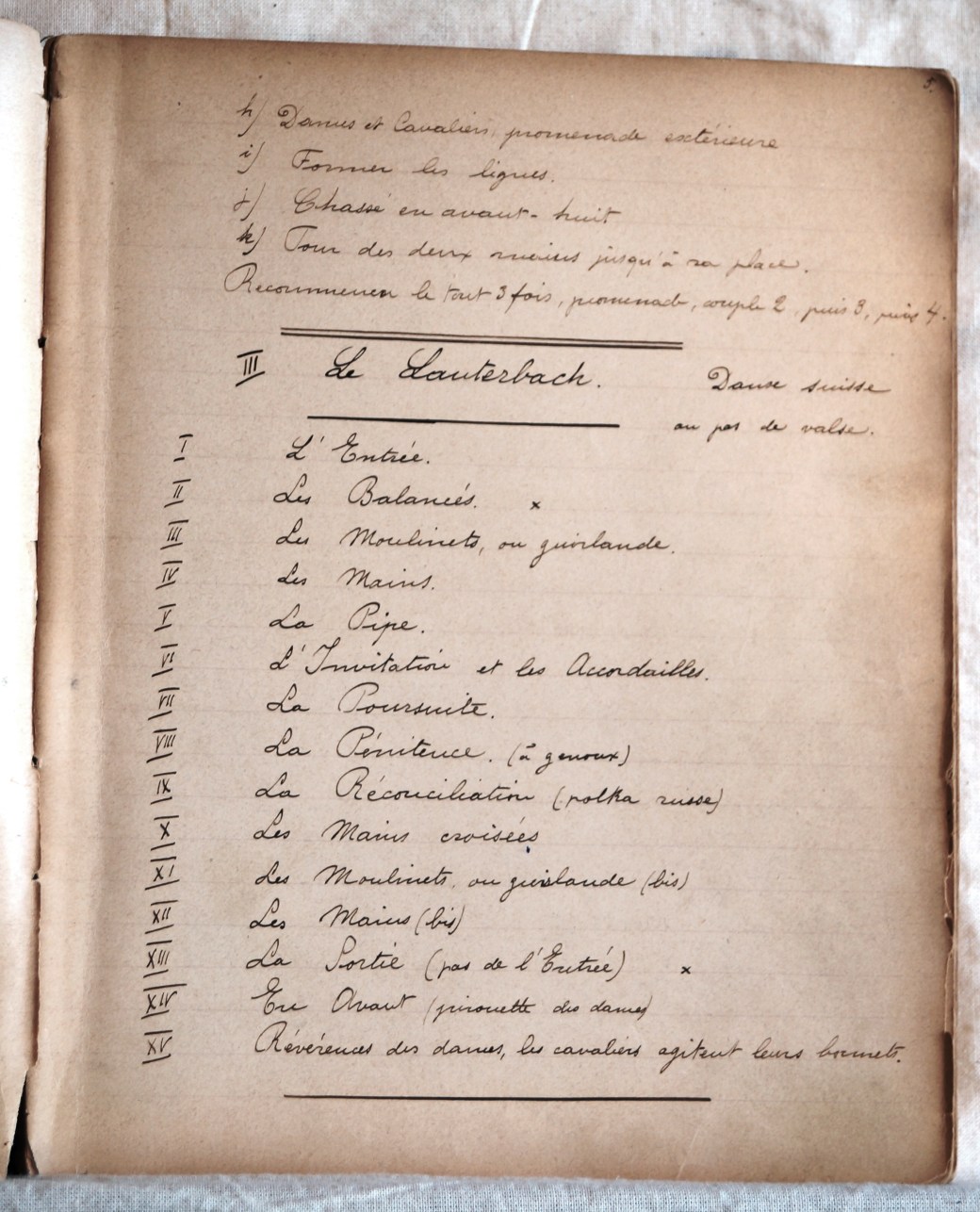
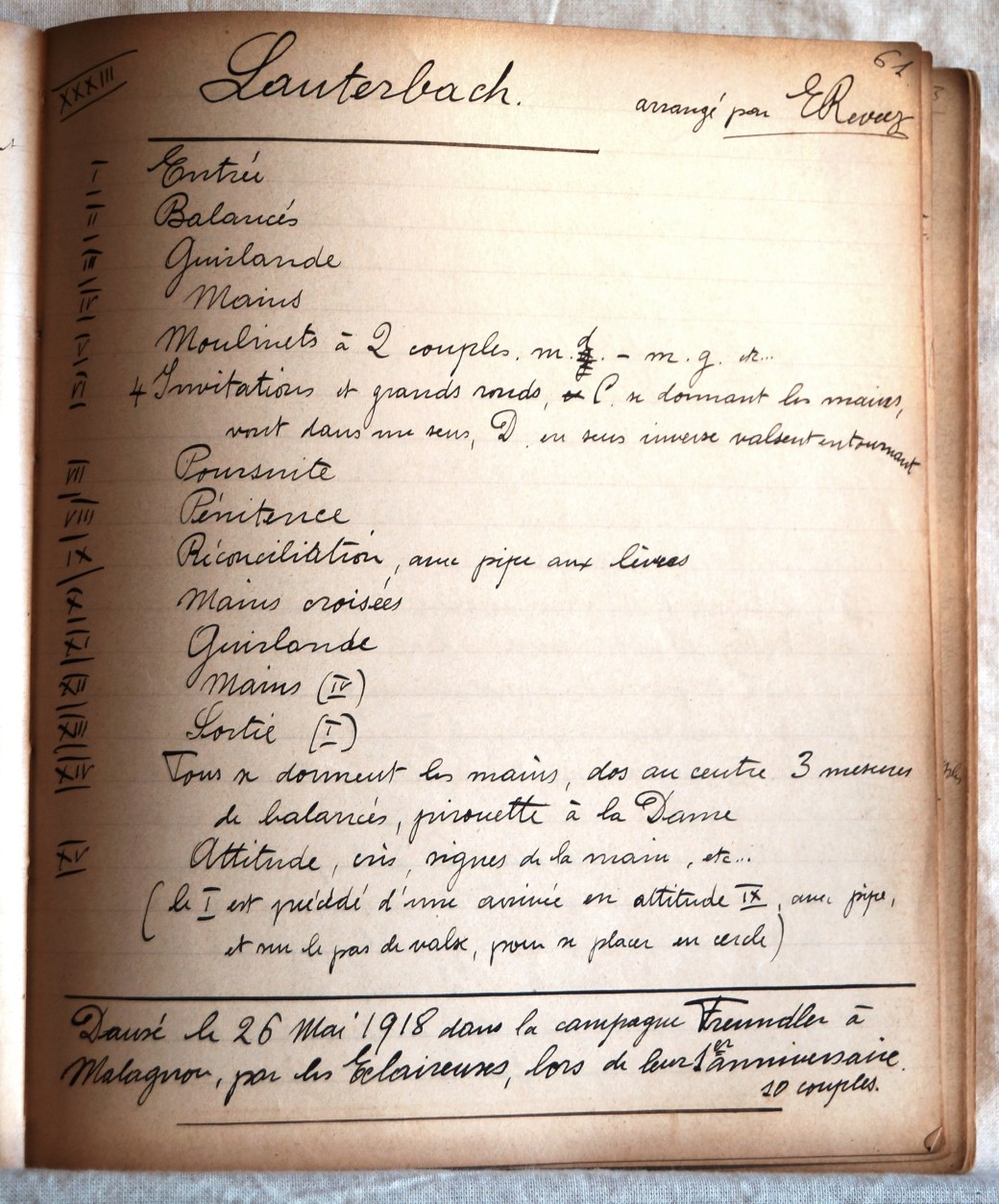
The Lauterbach reappears on page 61, with a record of a performance in 1918 at Malagnou in Geneva. Some figures are re-ordered, repeated or omitted compared to the original entry of about ten years earlier, and this new version is identified as ‘arranged by E Revuz’. His arrangement does, however, preserve the sense of courtship.
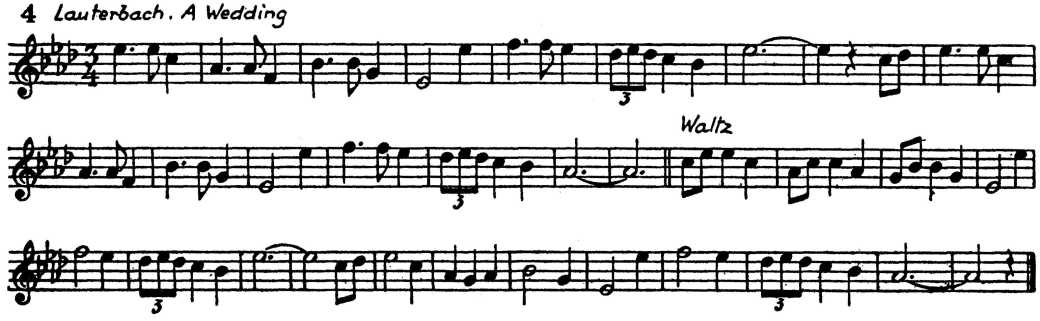
Violet Alford gives us one tune in her article Music and Dance of the Swiss Folk [3]:
- http://www.liederlexikon.de/lieder/zu_lauterbach_hab_i_mein_strumpf_verlorn
- J. J. Fuld, The book of world-famous music: classical, popular and folk Courier Corp. (2000)
- V. Alford, The Musical Quarterly, 27(4) 500-513 (1941)
 The Eugene Revuz Dance notebook