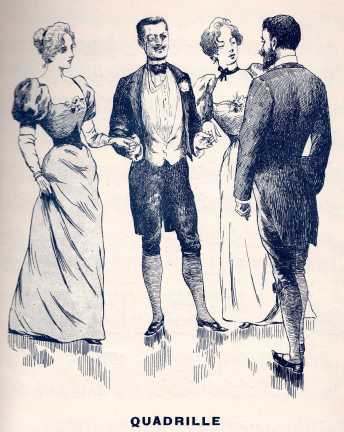
from the Petit Journal supplement “Album de Danses Illustrées“, 19th century, exact date unknown
As noted by the above source, the quadrille dates back to the beginning of the nineteenth century but some of its figures had their origins in the eighteenth century [1] (Rousseau introduced contredanses into his ballet of 1745, Fêtes de Polymnie, and the term Quadrille de contredanses later contracted to Quadrille). Philippe Musard (1792-1859) is credited with popularising the dance from the 1830s in Paris and also in London (after its first introduction there in 1815) as a composer, conductor and impresario.
This is the very first dance recorded by Revuz in his notebook in 1906. Some figures were therefore already over a century old when Revuz taught them but, as Edwin Ford Piper wrote in the USA in 1926, “the old square dances are not yet dead” [2].
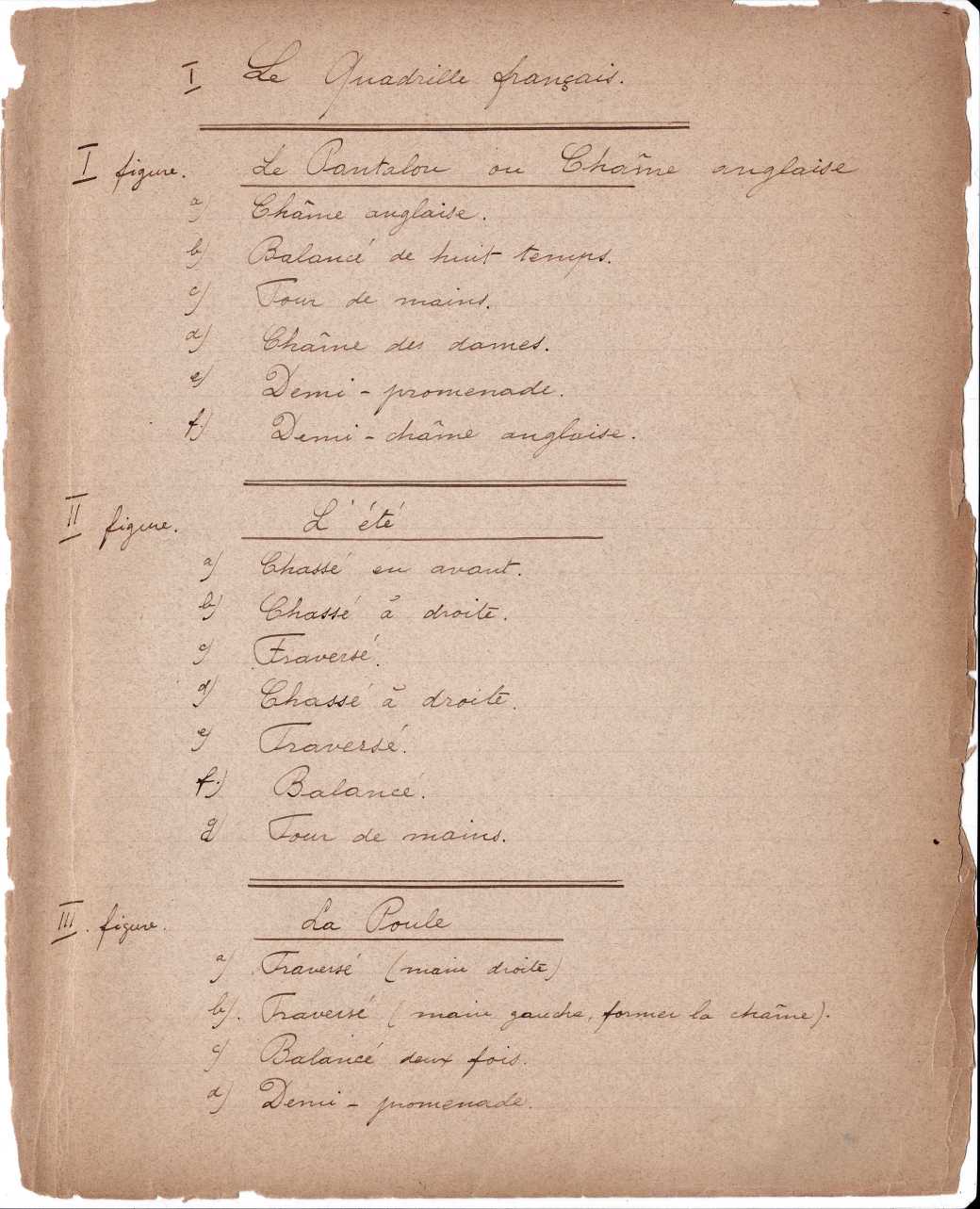
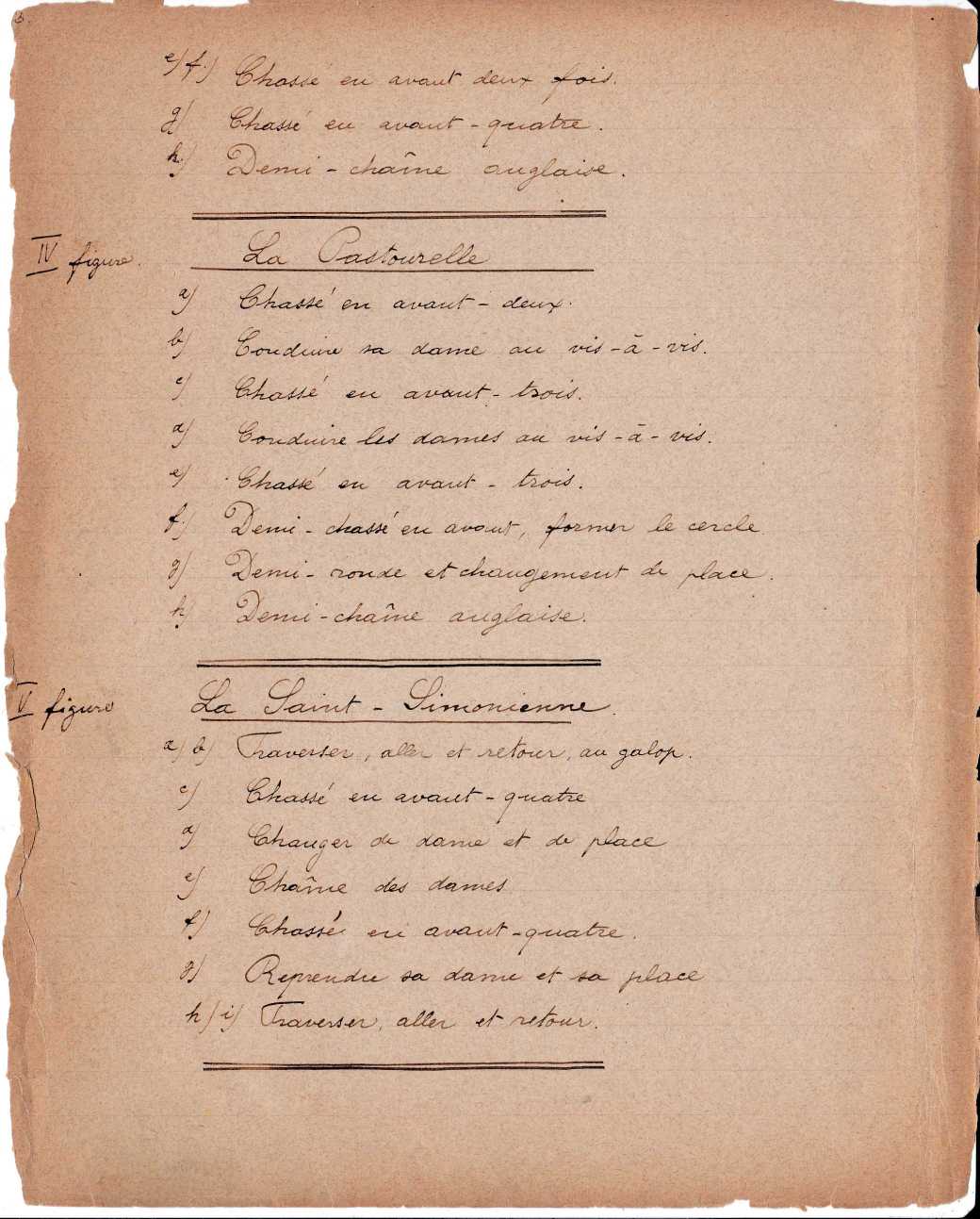
For the first four figures, Revuz’s Quadrille français follows the typical scheme of four contredanses as published, for example, in the Petit Journal volume: Le Pantalon, L’été, La Poule and La Pastourelle; he gives no indication what music he used but the contredanses alternated between 6/8 and 2/4 time. Revuz replaces the conventional Finale with the figure La Saint-Simonienne, named for its exchange of partners in a reference to the utopian doctrine of free love proposed by followers of Saint-Simon.
- J.-M. Guilcher, La Contredanse 2003 (orig. 1969) Editions Complexe
- E. F. Piper, American Speech 1(7) 391-395 (1926)
 The Eugene Revuz Dance notebook